

Search visibility is getting harder to win, even for businesses that publish regularly. Rankings shift faster, competition is stronger, and the old approach of guessing what Google wants is no longer enough. That is why so many marketers, freelancers, and business owners are paying close attention to the role of AI in SEO.
Used well, artificial intelligence can help you research keywords faster, uncover content gaps, improve on-page optimization, and spot patterns that would take hours to find manually. Used poorly, it can flood your site with thin content, bad advice, and pages that never rank. The difference is not the tool itself, it is how you use it.
This guide breaks down what AI for SEO actually means, where it helps most, and how to start without overcomplicating your workflow. Whether you run a small business site, manage client projects, or build products that depend on organic traffic, the goal is the same: use AI to make smarter SEO decisions, not noisier ones.
What Is AI in SEO?
At its core, AI in SEO means using artificial intelligence to improve how you plan, create, optimize, and measure search-focused content. Instead of relying only on manual research and instinct, you use machine-driven analysis to process large amounts of data and identify opportunities more quickly.
That can include everything from keyword clustering and search intent analysis to content briefs, title suggestions, internal linking ideas, and technical audits. AI can review patterns across thousands of search results far faster than a human can. This makes it especially useful for small teams that need leverage.
The important distinction is that AI is not a replacement for strategy. Search engine optimization still depends on clear positioning, credible expertise, useful content, and a strong user experience. AI speeds up parts of the work, but it does not automatically create authority or trust.
A helpful way to think about it is this: traditional SEO is like working with a compass and a paper map. You can still reach the destination, but it takes more time and interpretation. AI adds a dynamic navigation layer, it helps you see faster routes, missed turns, and hidden opportunities. You still have to decide where to go.

Why AI Has Become So Important for Search
SEO has always involved data, but the volume of that data has exploded. Search results now reflect intent, context, freshness, topical authority, user behavior, and competitive depth. Manually evaluating all of that is possible, but increasingly inefficient.
Artificial intelligence helps by finding relationships that are easy to miss. It can group related keywords, detect semantic coverage gaps, and surface themes across competitor pages. That gives you a more structured view of what search engines may expect from high-quality content in a given topic area.
There is also a practical reason for its rise. Content teams are under pressure to publish more, update faster, and prove results sooner. AI can reduce the time spent on repetitive tasks, which frees up more energy for strategy, editing, and quality control.
What AI Can and Cannot Do
AI can support idea generation, streamline research, and improve consistency. It is particularly useful when you need to organize large keyword lists, create first drafts, analyze page structure, or prioritize optimization opportunities across many URLs.
What it cannot do reliably on its own is understand your business nuance the way you do. It does not inherently know your customers, your competitive edge, or the lived experience behind your expertise. It can imitate authority, it cannot guarantee it.
That matters because search engines reward content that is genuinely helpful. If your workflow becomes fully automated, your site may start to sound polished but empty. Readers notice that quickly, and so do search systems designed to detect shallow content.
Key Aspects of AI for SEO
The value of AI becomes clearer when you look at the specific parts of SEO it can improve. Not every use case delivers the same impact, and not every business needs the same level of automation.
Keyword Research and Topic Discovery
One of the strongest use cases for AI in SEO strategy is keyword research. AI tools can process large sets of search queries and group them by similarity, intent, and topical relevance. That helps you move beyond isolated keywords and start building content around complete subject areas.
For example, instead of targeting only one term like “email marketing tips,” AI can help uncover related needs such as beginner setup, automation workflows, open rate improvement, segmentation tactics, and reporting questions. This leads to more comprehensive content planning.
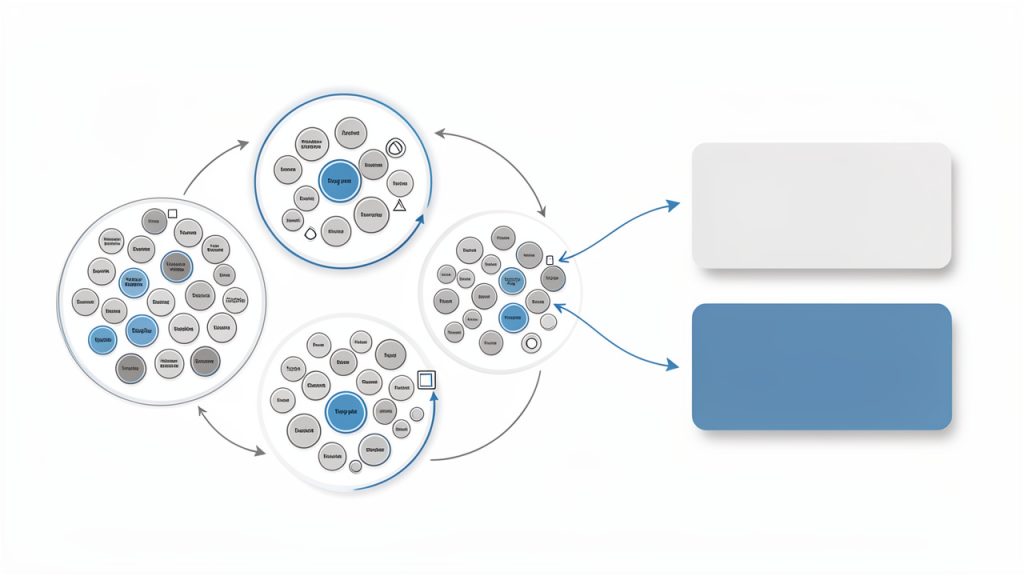
It also improves prioritization. Rather than chasing every keyword with volume, you can use AI-assisted analysis to identify themes that better match your audience and commercial goals. This matters because not all traffic is useful traffic. Relevance beats raw volume.
Search Intent Analysis
Search intent is one of the most important ideas in modern SEO, and AI is particularly good at pattern recognition. By analyzing search results at scale, AI can help you understand whether users want a guide, a tool, a product page, a comparison, or a quick answer.
That prevents a common mistake: creating the wrong type of content for the query. If the top results are all product comparison pages and you publish a short educational article, your page may struggle even if the writing is strong.
Intent analysis also helps with content depth. Some topics need a concise answer. Others need a full framework, examples, and visuals. AI can reveal those expectations faster by studying how successful pages are structured.
Content Creation and Optimization
This is the area that gets the most attention, and also the most misuse. AI can absolutely help with content creation. It can generate outlines, draft introductions, rewrite weak sections, suggest FAQs, and improve readability. For busy teams, that can cut production time significantly.
But there is a clear difference between AI-assisted writing and AI-dependent publishing. The first uses AI as a drafting partner, the second treats it like a substitute for expertise. That is where quality drops.
The best results usually come from a layered process. AI handles the heavy lifting of organizing ideas and producing a rough draft. A human then sharpens the argument, adds examples, checks accuracy, aligns the tone, and contributes real insight. That combination is far stronger than either approach on its own.
On-Page SEO Improvements
Artificial intelligence can also help optimize existing pages. It can suggest stronger titles, better subheading structures, improved keyword placement, missing entities, and clearer calls to action. This is useful when you already have content but need to make it more competitive.
In many cases, the gains come from clarity rather than keyword density. AI can identify where a page is vague, repetitive, or incomplete. It can also compare your page against similar ranking content and highlight missing subtopics.
That said, suggestions should not be followed blindly. If every recommendation is accepted mechanically, content can become formulaic. Search performance often improves when a page is both well optimized and distinctly useful.
Technical SEO and Site Analysis
Technical SEO can feel intimidating, especially for small teams. AI does not remove the need for technical knowledge, but it can make issue detection more accessible. It can summarize crawl problems, flag duplicate content risks, spot internal linking weaknesses, and identify pages that may be underperforming due to structural issues.
This is especially helpful when a website has grown quickly. Over time, many sites accumulate orphan pages, inconsistent metadata, redirect chains, and outdated content. AI can surface these patterns more quickly than a manual page-by-page review.
For developers and technically minded site owners, AI can also speed up diagnosis. Instead of just listing errors, better systems can explain likely causes and suggest practical fixes in plain language. That shortens the gap between noticing a problem and acting on it.
Competitor Analysis
Competitor research is often where AI saves the most time. Reviewing rival pages manually takes effort, especially when you are comparing multiple domains across many keywords. AI can summarize content themes, ranking patterns, topical gaps, and structural differences much faster.
This can reveal opportunities that are not obvious at first glance. You might discover that competitors rank not because they write better, but because they answer a broader range of related questions. Or you may find that a weaker-looking site is winning with stronger internal linking and clearer page intent.
The point is not to copy competitors. It is to understand the landscape so you can build something more complete, more useful, or more focused for your audience.
Performance Forecasting and Workflow Efficiency
Another growing benefit of using AI in SEO is operational. Beyond rankings and content, AI can help teams prioritize work. It can identify which pages are most likely to benefit from an update, which topics deserve expansion, and where effort is unlikely to pay off.
That kind of forecasting matters when resources are limited. Most small businesses and freelancers cannot optimize everything at once. AI can act like a filter, helping you decide what deserves attention first.
The efficiency gains are real, but they should be measured carefully. Faster output is only valuable if it leads to better outcomes. Publishing twice as much mediocre content rarely beats publishing fewer, stronger pages with a clear purpose.
How to Get Started With AI for SEO
Getting started does not require a complex stack or a large budget. In fact, the smartest approach is usually the simplest one. Begin by improving one part of your workflow where time is being lost or quality is inconsistent.
Start With a Specific Use Case
If you try to apply AI to every SEO task at once, you will likely end up with clutter instead of clarity. A better approach is to choose one focused use case. For some teams, that is keyword clustering. For others, it is content brief creation, content updates, or metadata optimization.
When you begin with a narrow goal, it becomes easier to judge whether AI is actually helping. You can compare speed, quality, and outcomes against your old process. That gives you a practical baseline instead of relying on hype.
A simple first step is to take an existing topic and use AI to organize related keywords and subtopics. Then compare that output to what you would have planned manually. In many cases, you will find useful patterns, but also some irrelevant suggestions. That is normal. The skill lies in filtering.
Keep Human Review in the Loop
The fastest way to damage your SEO is to publish AI-generated content without meaningful review. Even when the writing sounds smooth, it may contain vague claims, outdated advice, or filler that adds no value.
Human review protects quality. It ensures the content matches your brand, reflects your audience’s real questions, and includes details AI cannot invent responsibly. This is especially important in industries where trust matters, such as finance, health, legal services, or B2B consulting.
Think of AI as your first-pass assistant, not your final editor. It can accelerate the early stages, but judgment still belongs to the human side of the workflow.
Build a Repeatable Process
SEO becomes more effective when it is systematic. If AI is going to help, it should fit into a repeatable process rather than being used randomly from task to task.
A practical starter workflow often looks like this:
- Research the topic and gather search queries, competitor pages, and audience questions.
- Use AI to organize patterns such as intent, clusters, missing subtopics, and content structure.
- Create or revise content with human expertise, examples, and brand-specific positioning.
- Review performance after publishing, then update based on impressions, clicks, and ranking movement.
This kind of structure keeps AI grounded in real SEO work. It also makes it easier to improve over time because you can see where the output was genuinely useful and where it created extra editing.
Focus on High-Leverage Pages First
Not every page deserves the same level of effort. If you are new to AI-assisted SEO, start with pages that can produce visible results. That usually means service pages, high-intent blog posts, product category pages, or aging content that already gets impressions but underperforms.
These are the pages where better structure, stronger relevance, and fresher information can have an outsized impact. AI can help you identify what is missing, but the page still needs a clear business objective and a useful reader experience.
That is why page selection matters. You do not need hundreds of AI-touched pages. You need a handful of pages where improved optimization can actually move traffic or conversions.
Measure More Than Output
It is easy to get impressed by speed. A tool that creates ten content ideas in seconds feels productive. But SEO success is not about how quickly assets are produced. It is about whether they rank, earn clicks, satisfy visitors, and support business goals.
So measure outcomes, not just activity. Track whether AI-assisted pages attract better traffic, whether content updates improve visibility, and whether search visitors convert at a useful rate. If those numbers do not improve, the workflow may be efficient but ineffective.
The table below shows the difference between a healthy and unhealthy approach to using AI for SEO.
| Approach | Healthy Use of AI | Risky Use of AI |
|---|---|---|
| Keyword research | Clustering terms, spotting themes, identifying intent | Chasing every suggestion without relevance |
| Content creation | Drafting, outlining, and speeding up research | Publishing unedited, generic copy at scale |
| Optimization | Improving clarity, coverage, and structure | Overstuffing keywords based on tool prompts |
| Technical SEO | Summarizing issues and prioritizing fixes | Trusting automated recommendations blindly |
| Reporting | Surfacing trends and opportunities | Focusing on vanity metrics only |
Common Mistakes to Avoid
Many early mistakes with AI in SEO come from unrealistic expectations. Some users assume AI will replace expertise. Others assume more content automatically means more rankings. Neither assumption holds up for long.
The most common problem is sameness. When everyone uses similar prompts and publishes lightly edited drafts, content starts to blend together. It may be readable, but it lacks the specificity that makes a page worth ranking or sharing.
Another mistake is skipping fact-checking. AI can sound certain while being wrong. In SEO, inaccurate content is more than embarrassing. It can hurt trust, weaken conversions, and create expensive cleanup work later.
Conclusion
Artificial intelligence is changing SEO, but not by making strategy obsolete. Its real value is speed, pattern recognition, and support across research, optimization, and analysis. When used carefully, it helps small teams work with more precision and less wasted effort.
The strongest approach is simple: use AI to handle repetition and surface insights, then rely on human judgment to shape the final result. Start with one use case, test it on important pages, and measure whether it improves outcomes. That is how AI for SEO becomes a practical advantage instead of just another trend.
Your next step is to pick a single workflow, whether keyword research, content optimization, or content brief creation, and improve it with AI this week. Keep the process lean, review everything with a human eye, and build from what actually works.