

Frontend interviews can feel deceptively simple. You look at the job description, see familiar words like HTML, CSS, JavaScript, React, and assume a few review sessions will be enough.
Then the interview starts, and suddenly you are asked to explain event delegation, compare == and === (MDN), discuss rendering performance, or build a component while narrating your decisions in real time.
That gap between knowing frontend development and being able to answer common frontend interview questions clearly is what trips up many candidates. Interviewers are rarely checking only whether you have memorized definitions. They want to see how you think, how you prioritize, how you debug, and whether you understand the trade-offs behind the tools you use every day.
If you want to prepare for common questions in frontend interviews, the smartest approach is not endless cramming, it is structured preparation. You need a clear understanding of the topics that appear most often, the reasoning interviewers expect, and a repeatable way to practice. Once you do that, interviews become much less unpredictable and much more manageable.
What It Means to Prepare for Common Frontend Interview Questions
Preparing for frontend interviews is not just about collecting a giant list of questions and trying to memorize perfect answers. It is about building fluency across the core areas of frontend work. That usually includes HTML semantics, CSS layout, specificity, JavaScript fundamentals, browser behavior, accessibility, performance, frameworks, testing, and practical problem-solving.
A good frontend interview often blends theory with real-world scenarios. One moment you may be asked what semantic HTML is, and the next you may need to explain why a page feels slow, how to improve a component’s accessibility, or what happens when a browser parses a script. In that sense, preparation is less like studying flashcards, and more like training for a conversation where your technical judgment matters.
When candidates search for how to prepare for frontend interview questions, they usually mean learning to answer with both accuracy and context. For example, it is not enough to say that Flexbox is for one-dimensional layouts and Grid is for two-dimensional layouts. A stronger answer explains when each is more maintainable, how browser support factors in less today than in the past, and why choosing the right layout model reduces future complexity.
What Interviewers Are Actually Evaluating
Frontend interviewers are usually looking at several things at once. They care about technical correctness, but they also care about communication. If you know the answer but explain it in a confusing way, that can weaken your performance. If you make a small mistake but reason through it well, that can actually help.
They also want to know whether your knowledge is shallow or durable. Someone who has only memorized terms often struggles when a question is reframed. Someone who understands the underlying concept can still answer when the exact wording changes. That is why interview preparation should focus on patterns, not just scripts.
Another important factor is practical awareness. Modern frontend work is not isolated coding, it touches user experience, collaboration, performance, maintainability, and cross-browser behavior. The best answers often reflect that broader understanding.
Key Aspects of Preparing for Frontend Interviews
Master the Core Frontend Foundations
The most common frontend interview questions still revolve around the basics. That surprises some candidates, especially those who have spent most of their time inside a framework. But strong frontend teams know that frameworks change, while the foundations remain essential.
With HTML, expect questions about semantic elements, document structure, forms, accessibility, and SEO implications. Interviewers may ask why a <button> is better than a clickable <div>, or how proper heading hierarchy improves both usability and page structure. These questions sound basic, but they reveal whether you understand the web as a platform, not just as a canvas for components.
With CSS, common questions often focus on the box model, positioning, specificity, inheritance, stacking context, Flexbox, Grid, responsive design, and layout debugging. Many interviewers also like scenario-based prompts, such as how you would center an element, build a responsive card layout, or prevent layout shifts. Strong answers connect CSS choices to maintainability and user experience, not just visual output.
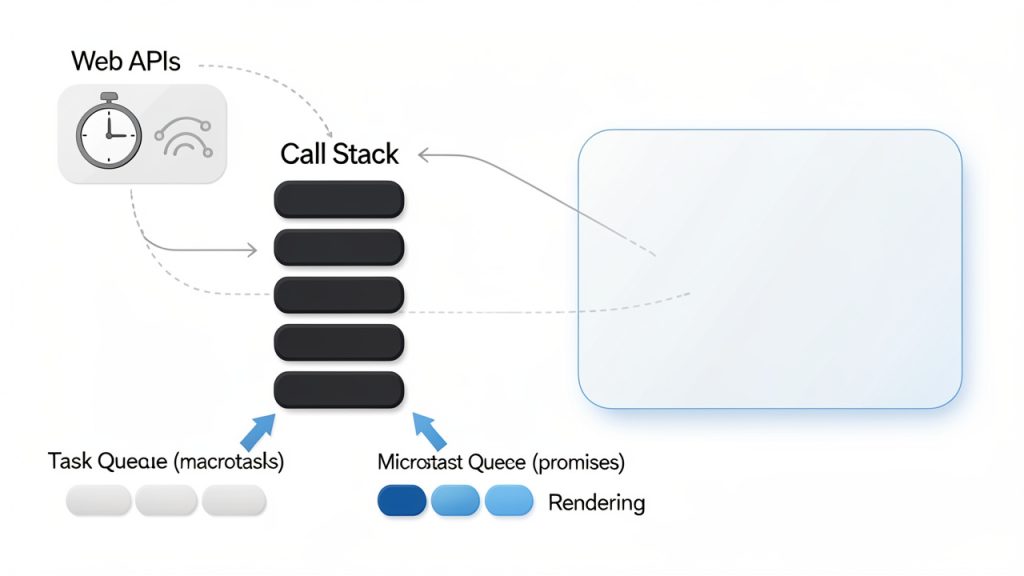
With JavaScript, the scope gets wider. You may be asked about data types, closures, scope, hoisting, promises, the event loop, asynchronous programming, prototypes, this, array methods, immutability, and DOM manipulation. This is often where candidates feel the most pressure because JavaScript questions can move from beginner-friendly to deeply conceptual very quickly.
Understand Browser Behavior, Not Just Syntax
A frontend developer works in the browser, so interviewers often test whether you understand how the environment behaves. This includes rendering, repaint versus reflow, caching, parsing, script loading, and how the DOM and CSSOM interact. You do not need to answer like a browser engineer, but you should understand enough to explain common performance and behavior issues.
For example, if asked why a page is slow, a strong candidate might talk about oversized bundles, too many render-blocking resources, expensive DOM updates, unnecessary re-renders, image optimization, and network latency. That answer shows applied thinking. It turns abstract knowledge into practical diagnosis.
The same is true for accessibility. Interviewers increasingly ask about keyboard navigation, ARIA usage, color contrast, focus management, and screen reader support. Accessibility is no longer a nice extra, it is part of competent frontend engineering. If you can explain how semantic HTML reduces the need for excessive ARIA, you already sound more experienced.
Be Ready for Framework-Specific Questions
If the role mentions React, Vue, Angular, or another framework, expect interview questions tailored to that ecosystem. In React interviews, for example, common topics include component lifecycle, hooks, state management, props, controlled versus uncontrolled inputs, memoization, reconciliation, and rendering behavior.
The mistake many candidates make is answering framework questions as if they are reciting documentation. Interviewers usually want to know how you use the framework to solve problems. If asked about useEffect, a better answer goes beyond syntax. Explain when to use it, when not to use it, how dependencies affect execution, and what kinds of bugs can happen if it is misused.
Framework knowledge is strongest when tied back to the underlying platform. A candidate who understands both React and the DOM often performs better than a candidate who only knows React patterns in isolation.
Expect Practical Coding and Debugging Questions
Not every frontend interview includes a live coding exercise, but many do. The task may be small, such as building a search filter, implementing a debounce function, or styling a responsive component. Sometimes the challenge is less about finishing and more about showing your approach.
Interviewers pay attention to how you break down the problem, how you name things, whether you consider edge cases, and how you recover when something goes wrong. In frontend roles especially, debugging is often just as important as writing new code. You may be given a broken UI and asked to identify the issue, or shown a piece of code and asked how you would improve it.
That means your preparation should include speaking while coding. Silent competence can be hard for an interviewer to evaluate. Clear reasoning, even when imperfect, often creates a stronger impression than a flawless but unexplained solution.
Prepare for Behavioral Questions with a Frontend Lens
Frontend interviews are not purely technical. You will likely be asked about collaboration, feedback, deadlines, and trade-offs. These questions matter because frontend developers frequently work across design, product, backend, QA, and support teams.
A generic answer about teamwork is usually weak. A stronger answer uses frontend-specific situations. For instance, you might describe how you handled conflicting design requirements, advocated for accessibility despite time pressure, or improved performance without disrupting the release schedule. This shows maturity and real-world experience.
Behavioral questions also reveal how you handle constraints. Frontend work often involves balancing ideal solutions with practical timelines. Employers want people who can make thoughtful decisions under real conditions.
Common Frontend Interview Questions You Should Be Able to Answer
The exact questions vary, but some themes appear again and again. The table below shows a practical way to think about them.
| Topic Area | Common Question | What Interviewers Want to Hear |
|---|---|---|
| HTML | What is semantic HTML and why does it matter? | Understanding of structure, accessibility, maintainability, and SEO |
| CSS | What is the difference between Flexbox and Grid? | Clear explanation of layout use cases and trade-offs |
| CSS | How does specificity work? | Ability to reason about style conflicts and maintainable CSS |
| JavaScript | What is a closure? | Conceptual understanding plus a practical use case |
| JavaScript | Explain the event loop | Awareness of async execution, call stack, task queues |
| JavaScript | Difference between == and === |
Type coercion knowledge and safe comparison habits |
| Browser | What causes reflow and repaint? | Performance awareness and rendering cost understanding |
| Accessibility | How do you make a component accessible? | Semantic markup, keyboard support, focus states, ARIA when needed |
| React | What is the difference between state and props? | Core component model understanding |
| React | When would you use useEffect? |
Ability to explain side effects and dependency management |
| Performance | How would you optimize a slow frontend app? | Structured thinking across network, rendering, code splitting, assets |
| Testing | What should be tested in a frontend app? | Balanced view of unit, integration, and user-focused testing |
You do not need a rehearsed speech for every question. What you need is a reliable answer framework. Start with a concise definition. Then explain why it matters. Then give a practical example. That structure works across a huge range of interview topics.
For instance, with closures, define the concept simply. Then explain that closures allow a function to retain access to variables from its outer scope. Finally, mention real uses such as data privacy, event handlers, or factory functions. That format feels natural and demonstrates actual understanding.
How to Build Better Answers Instead of Memorizing Scripts
Use the Definition, Context, Example Method
A common reason candidates freeze is that they try to remember the perfect wording. That rarely works under pressure. A better method is to build answers in three parts, definition, context, and example.
The definition proves you know the concept. The context shows why it matters in frontend work. The example makes the answer concrete. This is much easier to recall than a rigid paragraph, and it sounds more human in conversation.
Take event delegation as an example. You can define it as attaching a single event listener to a parent element to handle events from child elements through bubbling. Then give context by explaining that it helps with performance and dynamic content. Then share an example like handling clicks in a list where items are added later. That answer is both technical and practical.

Practice Explaining Trade-Offs
Senior and mid-level frontend interviews often become more interesting when trade-offs enter the conversation. It is one thing to define server-side rendering, it is another to explain when it helps, when it adds complexity, and what kinds of applications benefit most.
Trade-off thinking is a strong signal of real experience. It shows that you do not treat tools as magic. You understand that every choice affects maintainability, performance, developer experience, and user outcomes. If you can explain why one solution is appropriate in one case but excessive in another, your answers become much more credible.
This applies to styling strategies, state management, testing approaches, and optimization techniques. Mature frontend engineering is rarely about one universally correct answer, it is about making informed decisions under constraints.
How to Get Started with Frontend Interview Preparation
The most effective way to prepare for common frontend interview questions is to create a focused study plan. Random review sessions often feel productive, but they leave major gaps. A better approach is to separate your preparation into core foundations, framework knowledge, coding practice, and communication.
Start by identifying the role level and stack. If you are interviewing for a junior frontend role, the emphasis may be on HTML, CSS, JavaScript fundamentals, and simple component work. If you are interviewing for a mid-level or senior role, expect deeper questions about architecture, performance, testing, accessibility, and collaboration.
Then review the fundamentals in a deliberate order. HTML and accessibility first, then CSS and layouts, then JavaScript concepts, then browser behavior, then your framework. That sequence works because it mirrors how frontend applications are actually built. It also helps you connect higher-level abstractions back to the platform underneath.
A Simple Preparation Routine
If you need a starting point, keep it compact and repeatable:
- Review one core topic daily, such as closures, Flexbox, semantic HTML, or React state.
- Answer 3 to 5 common interview questions out loud without reading notes.
- Solve one small coding or debugging problem related to frontend work.
- Refine one weak answer by adding context and a real example.
This kind of routine works because it combines recall, explanation, and practical application. It also exposes weak spots quickly. If you cannot explain something simply, you probably do not know it as well as you think.
Practice Out Loud, Not Only in Your Head
This step is often overlooked. Reading articles and watching videos can create the illusion of readiness, but interviews are verbal. You need to hear yourself explain concepts. That is how you notice where your answer is vague, rambling, or too abstract.
Practicing aloud also improves pacing. Many candidates know the material but answer too quickly, too defensively, or with too much jargon. When you rehearse speaking, you become more comfortable giving concise and structured responses. That alone can significantly improve interview performance.
If possible, do mock interviews with another developer. If not, record yourself. It may feel awkward, but it is one of the fastest ways to improve clarity and confidence.
Use Projects as Proof of Understanding
One of the best ways to prepare for frontend interviews and the common questions that come with them is to revisit your own work. Your projects are evidence. They give you real examples for technical and behavioral answers, and they help you move beyond textbook responses.
If an interviewer asks about performance optimization, it is much stronger to describe how you reduced bundle size, lazy-loaded components, or fixed unnecessary re-renders in a real project. If asked about accessibility, you can discuss keyboard navigation, semantic markup, or screen reader improvements you actually implemented.
Before any interview, review two or three projects you know well. Be ready to explain the architecture, the challenges, the trade-offs, the bugs, and what you would improve. These stories are often more memorable than polished definitions.
Know the Difference Between Not Knowing and Panicking
Even strong candidates get questions they cannot fully answer. What matters is how you respond. Interviewers usually do not expect perfection. They expect thoughtfulness, honesty, and the ability to reason from what you do know.
If you are unsure, start with the part you understand. Clarify the question if needed. Think aloud. Relate it to a nearby concept. That approach is much better than guessing wildly or going silent. Frontend work constantly involves ambiguity, so calm reasoning under uncertainty is itself a valuable skill.
Mistakes That Hurt Frontend Interview Performance
One frequent mistake is over-focusing on framework trivia while neglecting core web fundamentals. A candidate may know many React hooks but struggle to explain form behavior, CSS positioning, or the event loop. That imbalance becomes obvious quickly.
Another issue is giving answers that are technically correct but disconnected from real frontend work. Interviewers are usually not impressed by memorized definitions alone. They want relevance. Explain why the concept matters in a product, a team, or a user experience.
Candidates also hurt themselves when they rush into coding without clarifying the problem. In frontend interviews, requirements matter. Responsive behavior, accessibility, edge cases, and user interaction details often matter just as much as raw implementation speed. A few thoughtful questions at the start can make your solution much stronger.
Final Thoughts and Your Next Step
To prepare for common questions in frontend interviews, focus on understanding rather than memorization. Build confidence in the fundamentals, connect concepts to real browser behavior, practice framework-specific topics in context, and get comfortable explaining your reasoning out loud. That combination is what turns scattered knowledge into interview readiness.
Your next step is simple. Pick the top ten frontend interview questions most relevant to your target role, answer each one aloud using the definition, context, example format, and refine the weak spots. Do that consistently for a week, and your interviews will start to feel less like a test and more like a conversation you are ready to lead.