

Technical SEO problems rarely announce themselves. Your site can look polished, load fine on your laptop, and still quietly lose rankings because search engines cannot crawl key pages, understand your templates, or trust the signals your platform sends. For developers, that is where SEO stops being a marketing afterthought and becomes an engineering responsibility.
A strong technical SEO checklist for developers helps bridge that gap. It turns vague goals like “make the site SEO-friendly” into concrete tasks across crawling, rendering, metadata, performance, structured data, and indexation. If you build websites, maintain storefronts, or ship product updates, these are not optional details. They directly affect whether pages get discovered, indexed, and ranked.
What Is a Technical SEO Checklist for Developers?
A technical SEO checklist for developers is a practical framework for validating that a website is accessible, understandable, and performant for search engines. It focuses less on copywriting and keyword targeting, and more on the systems behind the site. Think routing, status codes, canonical tags, robots directives, structured data, Core Web Vitals, mobile rendering, and XML sitemaps.
This matters because search engines do not experience a site the same way a human does. A user may happily click through navigation and wait a second for content to render. A crawler, on the other hand, evaluates server responses, HTML structure, JavaScript dependencies, and the consistency of your indexing signals. When those technical layers are weak, even excellent content can struggle.
For developers, the value of an SEO checklist is consistency. It reduces regressions during redesigns, migrations, framework updates, and content deployments. It also makes SEO measurable. Instead of hearing that “traffic dropped,” you can inspect redirect chains, compare rendered HTML, verify canonical logic, or trace a noindex tag introduced in a release.
Key Aspects of a Developer-Focused Technical SEO Checklist
Crawlability and indexation come first
If search engines cannot crawl your pages, nothing else matters. The first priority is making sure important URLs are accessible and return the right HTTP status codes. Pages you want ranked should generally return 200 OK. Removed pages should return 404 or 410, and moved content should use 301 redirects. Soft 404s, broken internal links, and endless redirect loops create friction for both bots and users.
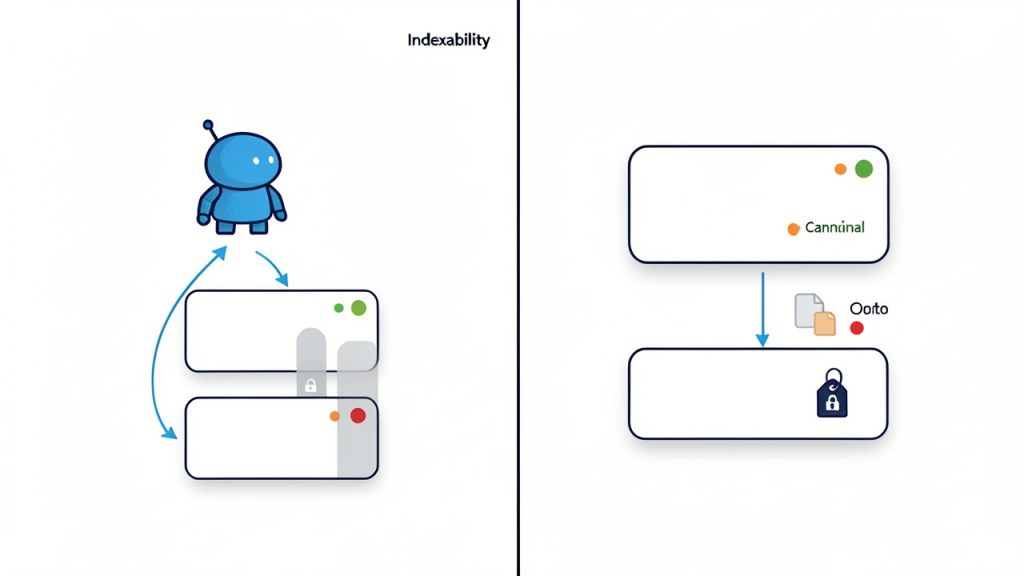
Indexation is the next layer. A page can be crawlable but still excluded from search if it carries a noindex directive, points to another canonical URL, or is blocked by robots settings in a way that prevents proper evaluation. This is where many sites get tangled. A developer may block staging correctly, then accidentally carry the same directive into production. Or a templating rule may inject canonical tags that all point to one category page.
The simplest way to think about it is this, crawlability is whether a bot can reach the page, and indexation is whether the bot is allowed and encouraged to store it in search results. Both have to work together.
Site architecture and internal linking shape discoverability
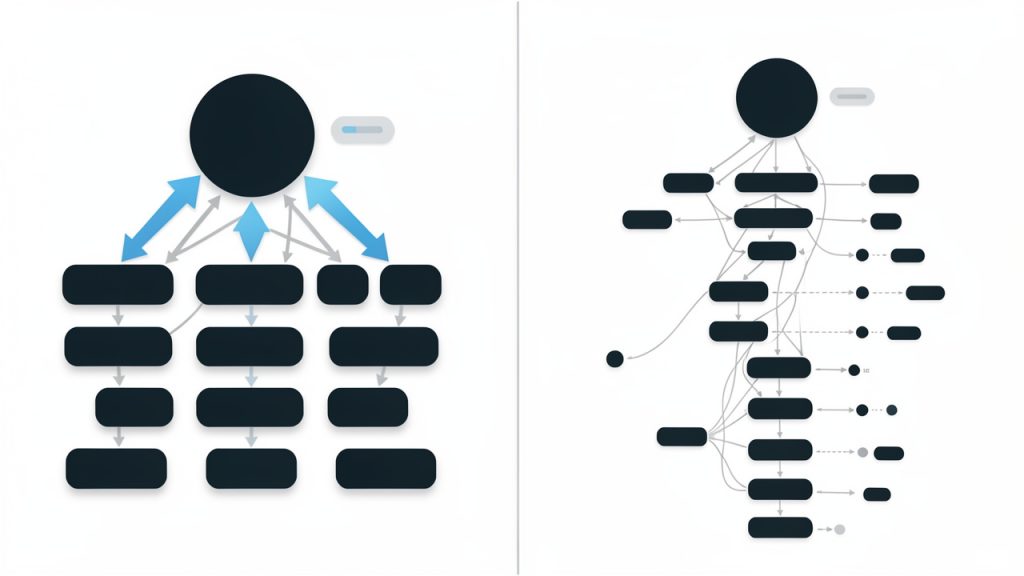
Search engines understand a website partly through its internal link structure. If important pages are buried deep, orphaned, or only accessible through filtered JavaScript states, they become harder to discover and less likely to accumulate authority. Good technical SEO often starts with clean architecture, not clever hacks.
A developer should pay close attention to URL structure, navigation components, breadcrumbs, pagination, and related-content modules. These elements are not just UX features. They are also discovery paths for crawlers. When internal links are rendered in standard HTML and point to canonical, indexable destinations, the site becomes easier to interpret.
Flat, logical architecture usually wins. A user should not need six clicks to reach an important product or service page, and neither should a crawler. If a page matters to the business, it should be prominently linked from relevant sections of the site.
Rendering and JavaScript can make or break visibility
Modern sites often rely on JavaScript frameworks, client-side rendering, and hydration. These can work for SEO, but they require discipline. Search engines have improved at processing JavaScript, yet rendering is still more fragile than serving meaningful HTML upfront. If critical content, links, or metadata appear only after complex client-side execution, you are increasing risk.
Developers should verify what the initial HTML contains before JavaScript runs. Page titles, meta descriptions, canonicals, headings, body content, and internal links should ideally be present or reliably rendered in a way crawlers can access. Heavy reliance on deferred scripts, blocked resources, or API calls can delay or obscure key content.
This is especially important on large sites where crawl budget matters. If every page requires significant rendering resources, search engines may process fewer URLs or revisit them less often. Server-side rendering or static generation often provides a more stable SEO foundation than fully client-rendered experiences.
Metadata and canonicals need system-level consistency
Metadata issues are common because they often come from templates rather than individual pages. A technically sound site should generate unique, accurate title tags, sensible meta descriptions, and consistent canonical tags across all major page types. Problems usually appear when template logic scales badly, such as duplicate titles across paginated pages or canonicals that point to non-indexable URLs.
Canonical tags deserve extra attention. They are hints that help search engines consolidate duplicate or near-duplicate content, but they are not magic fixes. If your site creates duplicate pages through tracking parameters, faceted navigation, session IDs, or print versions, canonical logic must align with your URL strategy. A bad canonical setup can quietly de-index valuable pages.
The same principle applies to hreflang for multilingual sites. If implemented, it must be reciprocal, accurate, and mapped to canonical URLs. Otherwise, search engines may ignore it or misinterpret regional targeting.
Structured data improves clarity, not rankings by itself
Structured data helps search engines understand the meaning of your content. For developers, it is one of the clearest technical SEO tasks because it involves explicit implementation. Product pages, articles, FAQs, organizations, reviews, breadcrumbs, and local business pages can all benefit when the schema matches the page intent.
That said, structured data is not a shortcut to ranking. It is a way to improve eligibility for rich results and reduce ambiguity. A page with weak content or poor crawlability will not suddenly perform because you added schema markup. The implementation has to be accurate, complete, and aligned with visible content on the page.
Developers should also treat schema as part of the application layer, not a one-off plugin setting. It should be tested after releases, validated, and updated as page templates evolve.
Performance affects both rankings and user behavior
Technical SEO and performance are deeply linked. Search engines want to rank pages that provide a good experience, and users abandon slow pages quickly. Core Web Vitals, including Largest Contentful Paint, Interaction to Next Paint, and Cumulative Layout Shift, give developers a concrete framework for improving load and stability.
The most useful mindset here is to focus on rendering priorities. Compress images, serve modern formats when appropriate, reduce unused JavaScript, preload essential assets carefully, and avoid layout shifts caused by late-loading fonts or media. Performance tuning is not just about hitting a score in a tool. It is about making the critical content visible and usable as early as possible.
For SEO, this matters twice. Faster pages improve user satisfaction, and they also make crawling more efficient, especially at scale.
Mobile-first indexing changes the baseline
Google primarily evaluates the mobile version of a site for indexing and ranking. That means mobile parity is no longer a “nice to have.” If your desktop page has strong content, internal links, and metadata, but the mobile version hides or strips important elements, the mobile version becomes the weak signal search engines see.
Developers should verify that the mobile experience includes the same key content, structured data, metadata, headings, and internal linking logic. Responsive design generally makes this easier, but component-level decisions still matter. Accordion content, hidden elements, oversized interstitials, or broken mobile navigation can all interfere with SEO outcomes.
Internationalization, pagination, and faceted navigation need careful control
Some of the hardest technical SEO work appears on large or dynamic sites. Ecommerce platforms, SaaS documentation hubs, and multi-region websites often generate huge numbers of URLs automatically. This is where developers need governance, not just optimization.
Faceted navigation can produce endless combinations of filtered URLs. Pagination can split authority awkwardly if internal linking is poor. International sites can create duplicate pages across countries or languages. In each case, the developer’s role is to define what should be indexable, what should remain crawlable but not indexed, and what should not be exposed at all.
These are strategic decisions as much as technical ones. The wrong setup can flood search engines with low-value pages while starving high-value pages of crawl attention.
A Practical Technical SEO Checklist for Developers
Below is a concise working checklist you can use during launches, redesigns, and ongoing maintenance.
| Area | What to check | Why it matters |
|---|---|---|
| HTTP status codes | Important pages return 200, moved pages use 301, removed pages return 404 or 410 | Prevents crawl waste and confusion |
| robots.txt | No accidental production blocks, sensitive areas handled intentionally | Controls crawler access at scale |
| Meta robots | No unintended noindex or nofollow directives | Prevents valuable pages from being excluded |
| Canonical tags | Self-referential where appropriate, no contradictory canonicals | Consolidates duplicate signals correctly |
| XML sitemap | Includes canonical, indexable URLs only, updated automatically | Helps discovery of important pages |
| Internal links | Key pages linked from navigational and contextual areas | Improves crawl paths and authority flow |
| Rendering | Critical content and links visible in rendered output | Ensures search engines can process pages |
| Titles and descriptions | Unique, relevant, template-controlled correctly | Improves clarity and click-through potential |
| Structured data | Valid schema aligned with visible content | Enhances eligibility for rich results |
| Page speed | Strong Core Web Vitals and efficient asset delivery | Supports rankings and UX |
| Mobile parity | Same essential content and metadata on mobile | Required for mobile-first indexing |
| Redirects | No chains, loops, or mass redirects to irrelevant pages | Preserves equity and user trust |
| Duplicate URLs | Parameters, filters, and alternate versions controlled | Reduces index bloat |
| Image SEO | Descriptive alt text, compressed files, crawlable image URLs | Supports accessibility and discovery |
| Logs and monitoring | Crawl behavior, errors, and indexation changes tracked | Helps catch technical issues early |
How to Get Started With Technical SEO Tasks as a Developer
Start with a baseline audit, not random fixes
Many teams jump into technical SEO by changing titles, adding plugins, or rewriting robots.txt without understanding the actual problem. A better approach is to audit the current state first. Crawl the site, inspect index coverage in search tools, review templates, and compare source HTML with rendered output. You want to see how the site behaves before deciding what to fix.
A baseline audit should answer a few practical questions. Which important pages are indexable? Which are missing from the sitemap? Are duplicate URLs being created unnecessarily? Are core page elements present without relying on late JavaScript? Is the mobile version equivalent to desktop in substance? Once you have those answers, prioritization becomes far easier.
Work through the highest-impact tasks first
Not every SEO issue deserves equal urgency. Some bugs are cosmetic, while others can wipe out visibility overnight. Developers should prioritize based on business impact and crawl/indexation risk. If a production deploy accidentally adds noindex to major templates, that outranks almost everything else. If your category pages are canonicalizing to the homepage, that is an emergency. Minor meta description duplication is not.
A useful order of operations is this:
- Fix indexation blockers such as noindex errors, robots misconfigurations, broken canonicals, and bad redirects.
- Resolve crawl and rendering issues so bots can access content and links reliably.
- Improve site architecture and internal linking to strengthen discovery and authority flow.
- Enhance performance and structured data to improve quality signals and search presentation.
This sequence keeps effort aligned with outcome. It also prevents teams from polishing secondary details while foundational issues remain unresolved.
Build SEO checks into your development workflow
The best technical SEO checklist is not a document that gets opened once a year. It is a set of checks embedded into design reviews, QA, staging validation, and deployment processes. That means developers should treat SEO-critical elements as part of acceptance criteria.
For example, when launching a new page template, verify title generation, canonical logic, schema output, mobile rendering, and internal linking before release. During migrations, map old URLs to new destinations, test redirect behavior, and compare traffic-driving pages before and after launch. For large applications, automated tests can help catch regressions in metadata or structured data.
SEO becomes much easier when it is operationalized. It becomes much harder when it depends on memory.
Use the right tools, but interpret them carefully
No tool can replace technical judgment. Crawlers, browser audits, server logs, and search console data are all useful, but each shows only part of the picture. A page might look healthy in a crawler while still being excluded from search because of duplicate intent, weak internal linking, or conflicting signals.
Developers should combine multiple viewpoints. Use crawlers to map site structure and metadata. Use browser tools to inspect rendering and performance. Use server logs to understand how bots actually behave. Use index reports to see what search engines include or exclude over time. The intersection of these sources is where reliable diagnosis happens.
Common technical SEO mistakes developers should avoid
Some SEO failures are surprisingly routine. A redesign launches with JavaScript-only navigation and no crawlable links. A framework update changes routing and creates duplicate trailing-slash URLs. Parameterized search pages get indexed at scale. A staging site is blocked correctly, but production inherits the same directive. Image lazy loading hides critical visuals from the initial viewport, hurting both UX and LCP.
These issues usually do not happen because developers ignore SEO. They happen because SEO requirements were not translated into technical rules early enough. The fix is not more panic after launch. The fix is better specification, testing, and ownership.
Key Aspects to Revisit During Redesigns and Migrations
Redesigns often preserve visuals, not visibility
A redesign can improve branding while damaging search performance if the underlying page structure changes carelessly. Heading hierarchy, internal links, content depth, URL structure, metadata templates, and schema output all need to be validated. Search engines do not rank color palettes. They rank accessible, consistent, interpretable pages.
Before launch, compare old and new templates side by side. Make sure important on-page content is still present. Confirm that URLs are either preserved or redirected cleanly. Check that navigation still exposes critical sections. It is common for visually elegant redesigns to reduce text, flatten category structures, or hide links in scripts that are less crawler-friendly.
Site migrations demand precision
Migrations are one of the highest-risk moments in technical SEO. Domain changes, CMS replacements, protocol updates, and major URL restructures can all trigger ranking losses if not handled carefully. The developer’s job is to preserve as much continuity as possible.
That includes creating a clear redirect map, retaining key content, updating canonicals, refreshing XML sitemaps, and validating internal links after launch. Redirecting everything to the homepage is not a migration strategy. It is a signal of lost relevance. Each important old URL should point to its closest new equivalent.
Monitoring after launch matters just as much as pre-launch checks. Watch crawl errors, indexation shifts, rankings, and bot behavior closely in the first few weeks.
How Small Teams Can Manage Technical SEO Without Overcomplicating It
Small business owners, freelancers, and lean product teams do not always have a dedicated SEO engineer. That is fine. Most technical SEO wins come from getting the fundamentals consistently right, not from chasing edge-case tactics.
If your resources are limited, focus on a smaller set of recurring tasks. Keep your important pages crawlable and indexable. Make sure titles, canonicals, and internal links are generated correctly. Maintain a clean XML sitemap. Test mobile rendering. Improve page speed where users feel it most. Validate structured data on your main templates. These habits will outperform sporadic, reactive fixes.
A lightweight process can be enough. One monthly crawl, one performance review, and one checklist pass before every release can catch a large percentage of avoidable SEO mistakes.
Conclusion
A good SEO checklist for developers that covers technical SEO tasks is really a reliability checklist for search visibility. It ensures your site can be crawled, rendered, indexed, understood, and trusted. It also gives developers something better than vague advice. It gives them specific systems to inspect and improve.
The next step is simple. Pick your top page templates, run a technical audit against the checklist above, and fix the highest-impact issues first. Once those checks become part of your development workflow, technical SEO stops being a scramble and becomes a competitive advantage.